


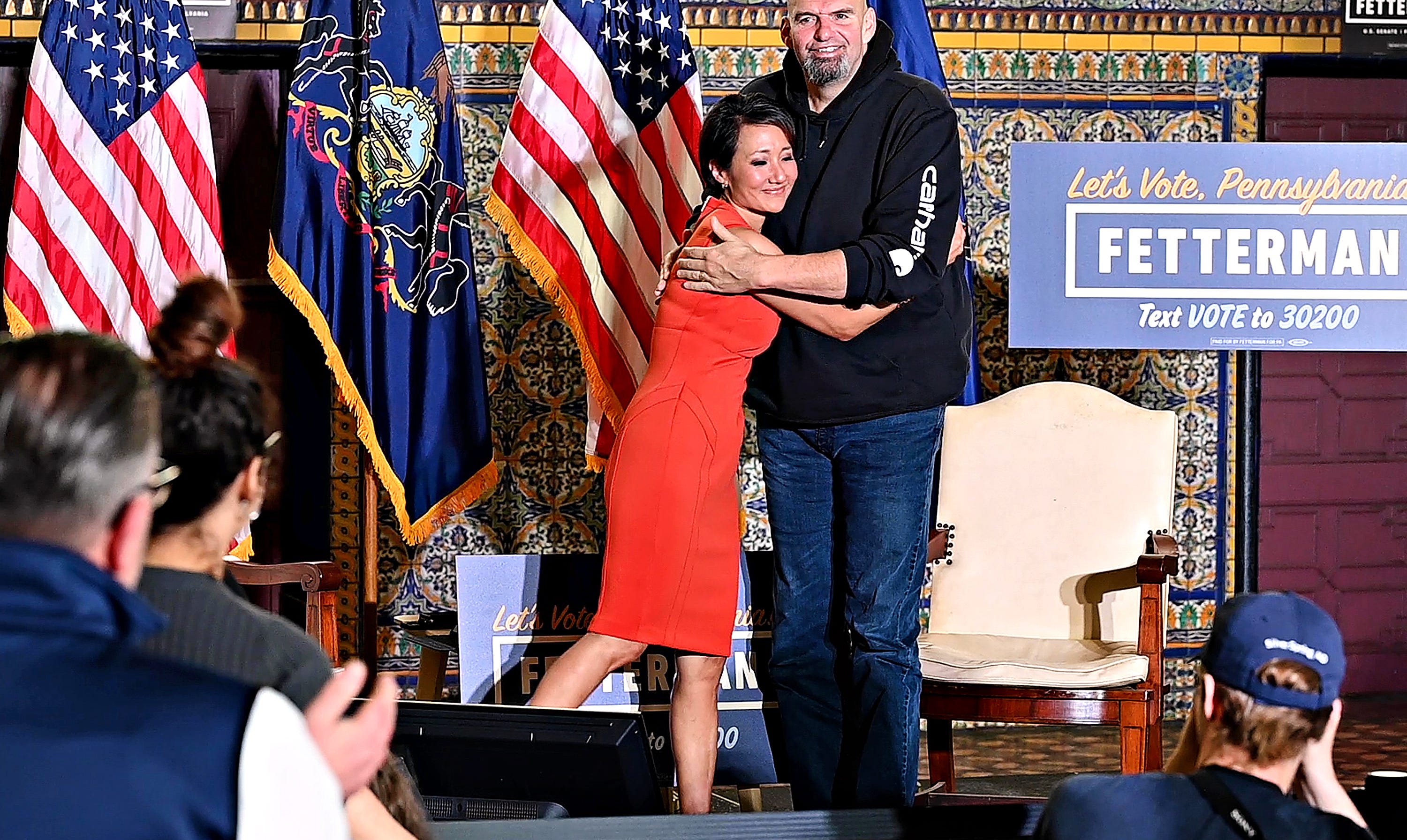


John Fetterman discusses health, crime, unions and more in Harrisburg
John Fetterman discusses health, crime, unions and more with State Rep. Patty Kim in Harrisburg, Sunday, Nov. 6, 2022.
York Dispatch
- Fetterman’s new memoir, “Unfettered,” details his political journey and his struggles with depression and anxiety following a stroke.
- The book describes his stubbornness. His family, according to Fetterman, had to trick him into going to the hospital for his stroke.
- Fetterman writes that he does not feel bound by party lines and is not concerned if his stances cost him his Senate seat in 2028.
John Fetterman writes frankly about suicide in his memoir, “Unfettered,” where the U.S. senator used his unconventional political rise to chronicle, since childhood, his struggles with mental health.
In the book, Fetterman tied his political journey to a gradually declining mental state that landed him in the traumatic brain injury unit at Walter Reed National Military Hospital for more than 40 days in 2023.
“My brain once again caught fire,” Fetterman wrote. He detailed a time when he irrationally feared his family would ditch him to flee the country forever. They could not see him at the time, so his wife, Gisele Fetterman, took their three kids to Niagara Falls, New York, for respite from the media onslaught.
Now the tattooed politician known for wearing brazenly casual hooded sweatshirts and shorts divulged he is not concerned about losing his Senate seat. The 56-year-old has yet to announce for reelection when his seat is up in 2028.
The York Dispatch’s attempts over the span of several years to interview Fetterman, a York County native, have been denied, although the senator occasionally sits for interviews on Fox News. At one point, Fetterman’s staff agreed to have the elected official sit down for an editorial board — but canceled the event a short time later.
>> Want to stay up to date on the latest news? Sign up for the Dispatch newsletters.
In the absence of public comments, Fetterman’s book offered his constituents their closest glimpse into his psyche and his outlook on the world.
Support for Trump policies: Despite criticism from some members of his own party, Pennsylvania’s former lieutenant governor wrote that he chose to support President Donald Trump on the polices he agrees with rather than labeling him an enemy.
Nonetheless, Fetterman’s Senate voting record put him in the middle of the pack among Democrats, according to GovTrack, which analyzes partisanship in Congress. Since 2023, Fetterman has missed 14% of all roll-call votes compared to the median 3% of all sitting senators.
“I have never viewed my political party as an iron shackle adhering me to the party line,” Fetterman wrote near the end of the book.
Fetterman’s support of Israel in its fight against Hamas, a consistent position of his, drew rebukes from Democrats. So did his votes for some Trump Cabinet appointees and his belief that open borders are chaotic rather than compassionate. He visited Trump at the Florida resort where the president also lives. Democrats accused him of “bending the knee” to Trump.
Most recently, Fetterman praised the Trump administration for capturing Venezuelan dictator Nicolas Maduro as “appropriate and surgical,” according to the Philadelphia Inquirer.
“I don’t know why we can’t just acknowledge that it’s been a good thing what’s happened. … We all wanted this man gone, and now he is gone,” Fetterman said Jan. 5 during an interview on Fox & Friends.
Simply put, he does not care what his fellow Democrats think of him.
Journal entries: “Unfettered” is largely a series of blunt journal entries that come across like Fetterman’s monotone voice. It was a quick read, if only for the short, choppy sentences spanning 21 chapters over 213 pages.
Candid passages from family, friends and advisors accompany his recollections, musings and anecdotes.
Fetterman’s thoughts were relatively plain as read. He did not break news, sticking to how he felt and how others dealt with his stubbornness. He had to be tricked into entering Lancaster General Hospital the day of his stroke. It was right before the Democratic primary in May 2022 for the midterm race he won against TV doctor and Republican Mehmet Oz.
Please consider subscribing to support local journalism.
“You couldn’t reason with him because he has no idea this is happening. He believes he is totally fine,” Gisele wrote about John’s sudden stroke episode.
In another entry, she wrote that her husband of nearly 18 years has an innate goodness about him.
“Complex, with all sorts of contradictions pulsing through him,” she wrote of his attributes.
These have been fully on display and frequently on camera in the United States’ upper congressional chamber for the last four years. It is not a place to hide for an introvert whose depression left him lying in a dark Washington, D.C., apartment for hours every day.
Struggles after stroke: Questions surrounding Fetterman’s fitness for office followed his stroke. They spurred a heavy diet of social media doom scrolling. He read — and obsessively harbored — a lot of negative things said and written about him.
He described it vividly: “Because of the way the brain works in depression — you are always searching for a way to hate yourself — I began to wonder if some of their insults were true.”
This is encapsulated after his disastrous October 2022 debate with Oz, when the pressure and criticisms of his health immediately intensified after some noticeable communicative struggles on stage.
“I was … reading tweets about the debate, shooting myself up with the shame that is too often the sustenance of the depressive. We seek self-flagellation,” he recalled in the book of his ride home to Braddock from Harrisburg.
Fetterman addressed formerly controversial topics like his frayed relationship with Gov. Josh Shapiro from their time on the state Board of Pardons and an incident where he was accused of vigilantism in going after a suspected shooter in Braddock.
Accusations, misinformation and media pressure ratcheted up his anxiety, worsening his depression. The two go hand-in-hand.
>> Want to stay up to date on the latest news? Sign up for the Dispatch newsletters.
Foreshadowing: The book practically foreshadowed his diagnosis. It detailed first a lonely and awkward childhood in York County that toughened him, experiences that helped shape someone who cares too deeply about things he cannot change on his own.
This borderline obsession took hold in Braddock, where he did everything he could to memorialize local victims of senseless murders. He tattooed the homicide dates on his arm.
He took that passion to the pardons board. As he put it, while others may have made moves for career-preservation or political reasons, he “did not vote to get on the right side of prison reform advocates.”
But the desire to impact change in the corrections system, a clear passion of his, came at a cost.
“When you can’t let go of something, when it eats you up inside and you go to bed thinking about it and wake up in the morning thinking about it, you will only suffer,” Fetterman wrote.
Fetterman said he was warned against going public with his struggles. Cautioned that his mental health would be weaponized against him, people told him it would take something normal and make it troubling.
The warnings, Fetterman wrote, proved truer than he ever could have imagined.
As the father of three closed his book, he grew increasingly deliberate as he advocated, whether intentionally or not, for mental health and destigmatizing people who are suffering.
Above his efforts to normalize depression and encourage people to seek therapy, Fetterman implored people against taking their own lives. He admitted he seriously considered suicide more than once.
In reading about depression, he claimed that more than two dozen people who survived suicide attempts by jumping from San Francisco’s Golden Gate Bridge said they regretted it the moment they jumped.
“Nobody said, ‘Damn, I wish that would have worked,’” Fetterman wrote about his findings. “As they climbed over the bridge railing and plummeted toward the San Francisco Bay at seventy-five miles an hour, their feeling was, ‘Holy s—. I want to live. I want to live. I want to live.’
Depression is an epidemic, he acknowledged. “You can get help. You are not alone, you are not going crazy.”
If you’ve experienced thoughts of suicide, confidential help is also available for free through the Suicide & Crisis Lifeline by calling 988 in the United States. You can find more information at 988lifeline.org.
— Reach Mark Walters at mwalters@yorkdispatch.com.
Please consider subscribing to support local journalism.
link