Women’s Health App Market Size, Trends, Share, Analysis, Growth
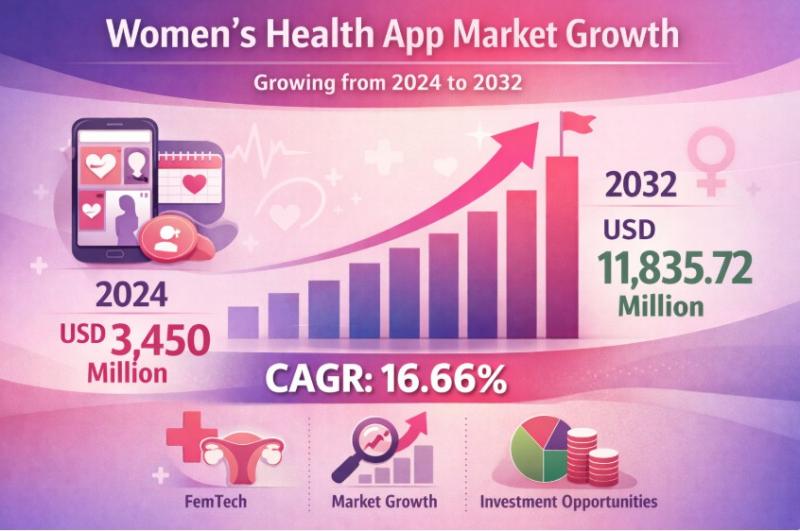
The women’s health app market is undergoing rapid expansion, reflecting a broader transformation in digital health, patient engagement, and personalized care delivery. The market is projected to grow from USD 3,450 million in 2024 to USD 11,835.72 million by 2032, registering a robust compound annual growth rate (CAGR) of 16.66%. This growth trajectory underscores the increasing integration of mobile technologies into women’s healthcare, rising consumer awareness, and the global shift toward preventive and self-managed wellness solutions.
Women’s health applications, once largely confined to menstrual tracking, have evolved into sophisticated platforms offering comprehensive services including fertility insights, pregnancy monitoring, nutrition planning, menopause management, mental health support, and chronic disease monitoring. The convergence of artificial intelligence, wearable technologies, and data-driven personalization has significantly expanded both the functionality and clinical relevance of these solutions.
Several macroeconomic and societal factors are contributing to market growth. First, there is growing recognition of gender-specific healthcare needs that were historically underserved. Second, the widespread adoption of smartphones and connected devices has lowered barriers to access, enabling women to actively manage their health. Third, healthcare providers and employers are increasingly incorporating digital tools into care models to improve outcomes, reduce costs, and enhance patient adherence.
Browse the full Report at https://www.credenceresearch.com/report/womens-health-app-market
Market Growth Drivers
One of the most significant growth drivers is the rising emphasis on preventive healthcare and wellness monitoring. Women are increasingly leveraging digital platforms for lifestyle management, reproductive health tracking, and early symptom detection. These tools empower users with actionable insights, encouraging proactive health decisions rather than reactive treatment.
Technological innovation is another key catalyst. Machine learning algorithms now support ovulation prediction, hormonal pattern recognition, and personalized fitness or dietary guidance. Integration with wearable devices allows continuous monitoring of physiological metrics such as heart rate variability, sleep quality, and activity levels, thereby enhancing app utility.
Additionally, evolving healthcare delivery models are reinforcing demand. Telehealth expansion, remote patient monitoring initiatives, and digital therapeutics adoption have created fertile ground for women-focused digital platforms. Insurers and employers are also recognizing the economic value of preventive women’s health management, particularly in areas such as maternity care and chronic disease prevention.
Get Free PDf Sample Request: https://www.credenceresearch.com/report/womens-health-app-market#request_sample
Market Challenges
Despite strong growth potential, the market faces notable challenges. Data privacy and regulatory compliance remain persistent concerns. Women’s health applications often process highly sensitive personal and medical data, requiring stringent cybersecurity measures and adherence to regional data protection regulations.
Clinical validation and medical credibility also pose hurdles. As applications expand into disease management and diagnostic support, developers must ensure evidence-based design and regulatory approvals. Furthermore, user retention and engagement can be difficult to sustain in a highly competitive and rapidly evolving app ecosystem.
Segmentation Analysis
Based on Type
Fitness & Nutrition applications represent a substantial portion of the market, driven by rising interest in holistic wellness and lifestyle optimization. These platforms offer tailored exercise routines, calorie tracking, dietary recommendations, and metabolic insights. Their appeal spans multiple age groups, particularly users seeking weight management, hormonal balance, or general health improvement.
Menstrual Health remains a foundational segment. Period tracking apps have transitioned from simple calendars to predictive systems incorporating cycle analytics, fertility windows, and symptom mapping. Growing openness around menstrual health discussions and reproductive awareness continues to drive adoption globally.
Pregnancy Tracking and Postpartum Care is among the fastest-growing categories. These applications provide fetal development updates, appointment reminders, nutrition guidance, and postpartum recovery monitoring. The integration of teleconsultation and remote monitoring features has enhanced their value proposition for both expectant mothers and healthcare providers.
Menopause management applications are gaining traction as aging populations and awareness of menopausal health issues increase. These platforms address symptom tracking, hormonal fluctuations, sleep disturbances, and mental well-being, catering to an often-overlooked demographic.
Disease Management applications are emerging as high-value solutions. These tools support monitoring and management of conditions such as polycystic syndrome (PCOS), endometriosis, osteoporosis, and cardiovascular disorders. Their growth reflects the increasing medicalization and clinical integration of digital health tools.
The Others category includes mental health, fertility planning, sexual wellness, and pelvic health applications, illustrating the expanding scope of digital women’s health ecosystems.
Get Free PDf Sample Request: https://www.credenceresearch.com/report/womens-health-app-market#request_sample
Based on Modality
The Smartphone segment dominates the market, reflecting the ubiquity, portability, and user convenience of mobile devices. Smartphones serve as primary health management hubs, enabling real-time data capture, wearable integration, and continuous user interaction.
The Tablet segment occupies a niche yet important position, particularly for teleconsultations, educational content consumption, and shared family usage scenarios. Larger displays enhance visualization of analytics and reports.
The Others category includes wearable-integrated systems, desktop interfaces, and emerging connected platforms, indicating ongoing diversification in device ecosystems.
Based on Age Group
The 25 to 34 Years demographic represents a critical market segment, driven by reproductive planning, pregnancy tracking, fitness engagement, and career-related wellness management. This group typically exhibits high digital literacy and strong willingness to adopt health technologies.
The 15 to 24 Years segment shows strong growth potential, fueled by early menstrual tracking adoption, sexual health education, and lifestyle management interests. Social media influence and digital-native behavior patterns support usage expansion.
The 35 to 44 Years group demonstrates increasing adoption for fertility management, preventive screening reminders, stress monitoring, and early menopause-related solutions.
The Above 44 Years segment is becoming increasingly important as menopause management, chronic disease monitoring, and healthy aging applications gain relevance.
Browse the full Report at https://www.credenceresearch.com/report/womens-health-app-market
Geographic Analysis
North America
North America leads the global market due to high digital health adoption, strong investment ecosystems, and advanced healthcare infrastructure. The U.S. drives innovation, venture funding, and platform development, while Canada benefits from supportive regulatory frameworks and growing consumer awareness. Mexico is witnessing rising adoption as mobile penetration increases and healthcare digitization accelerates.
Europe
Europe represents a mature yet dynamic market. Countries such as Germany, France, and the U.K. demonstrate strong demand driven by digital health initiatives, preventive care awareness, and FemTech innovation. Southern European markets including Italy and Spain are showing steady growth, supported by improving digital engagement and healthcare modernization. The Rest of Europe contributes through expanding telehealth ecosystems and rising wellness technology acceptance.
Asia Pacific
Asia Pacific is projected to experience the fastest growth, supported by large populations, rising smartphone penetration, and increasing health awareness. China and Japan benefit from technological sophistication and aging demographics. India represents a high-potential market driven by digital transformation, expanding healthcare access, and rising awareness of reproductive health management. South Korea and South-east Asia are also witnessing strong adoption fueled by tech-savvy populations and growing digital health investments.
Latin America
Latin America is emerging as a growth frontier. Brazil leads regional adoption due to expanding digital infrastructure and increasing consumer engagement with health technologies. Argentina and the Rest of Latin America are benefiting from rising mobile usage and healthcare accessibility challenges that digital tools can address.
Middle East & Africa
The Middle East & Africa region is gaining momentum, particularly within GCC Countries, where digital health investments and smartphone adoption are high. South Africa represents a key growth market due to rising health awareness and expanding connectivity. The Rest of the Middle East and Africa is gradually adopting women’s health apps as digital ecosystems mature.
Competitive Landscape and Key Player Analysis
The market features a diverse mix of specialized FemTech companies, technology giants, and healthcare innovators.
Ovia Health has established itself as a prominent player offering fertility, pregnancy, and parenting solutions. Its data-driven personalization and employer partnerships strengthen its competitive position.
Glow Inc. is recognized for its fertility and reproductive health tracking capabilities, leveraging predictive analytics and user engagement strategies.
HelloBaby, Inc. focuses on pregnancy and early parenting support, emphasizing user-friendly interfaces and educational resources.
Fitbit Inc. (Google LLC) integrates wearable technology with women’s health tracking, enhancing physiological monitoring and behavioral insights through connected ecosystems.
Mayne Pharma contributes to the ecosystem through pharmaceutical and therapeutic alignment, illustrating the intersection of digital health and medical treatments.
Flo Health Inc. is among the most widely adopted menstrual and reproductive health platforms globally, known for its AI-based predictions and broad user base.
Apple Inc. plays a pivotal role by embedding women’s health features within its hardware and software ecosystem, reinforcing mainstream adoption and data integration.
Natural Cycles USA Corp. differentiates itself through clinically validated fertility and contraception algorithms, representing a medically oriented segment of the market.
Maven Clinic Co. emphasizes virtual care delivery, connecting users with healthcare professionals across fertility, maternity, and menopause services.
Mithra Pharmaceuticals Group Limited exemplifies pharmaceutical innovation intersecting with women’s health, highlighting broader industry convergence.
Browse the full Report at https://www.credenceresearch.com/report/womens-health-app-market
Future Outlook
The women’s health app market is poised for sustained expansion, supported by technological advancements, rising healthcare consumerism, and expanding clinical integration. Artificial intelligence, predictive analytics, and remote monitoring capabilities will further enhance personalization and medical relevance. Additionally, partnerships among technology providers, healthcare systems, and employers are likely to accelerate adoption.
As digital health ecosystems mature, women’s health applications are expected to evolve from supportive wellness tools into core components of healthcare delivery, prevention strategies, and long-term disease management frameworks. The projected CAGR of 16.66% reflects not only strong consumer demand but also the structural transformation of healthcare toward accessible, data-driven, and patient-centered solutions.
Browse the full Report at https://www.credenceresearch.com/report/womens-health-app-market
Contact US:
Credence Research Inc, Tower C-1105 , S 25, Akash Tower,
Vishal Nahar, Pimple Nilakh, Haveli,
Pune – 411027, India
India – +91 6232 49 3207
[email protected]
www.credenceresearch.com
About US:
Credence Research is a leading international provider of market intelligence and a key component in the due diligence process. We deliver high-quality, extensive, deep-dive reports that empower leaders and investors to make informed decisions and mitigate risks. Our strategic insights, based on extensive research frameworks and advanced data modeling, provide authoritative primary sources for evaluating market performance and potential across a wide range of industries.
This release was published on openPR.
link